

What to Do If Your Car Key Snaps Inside the Ignition
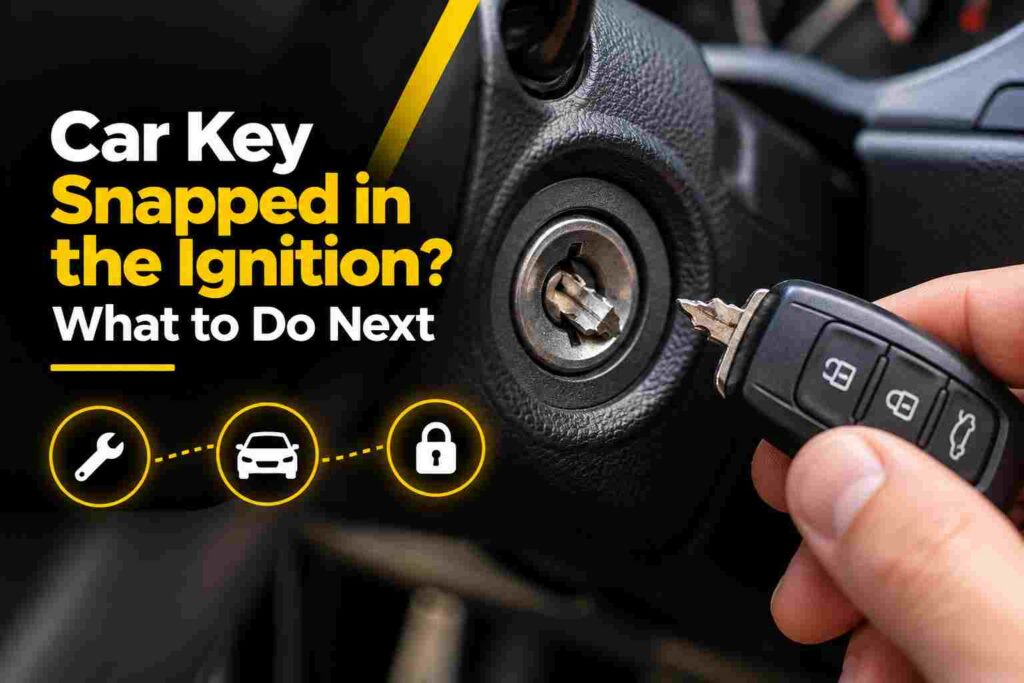
If your car key snaps inside the ignition, stop trying to turn it straight away. Keep hold of the part of the key that came away, avoid pushing tools into the ignition barrel, and do not insert your spare key while any broken metal is still inside.
In many cases, the broken blade can be extracted without replacing the whole ignition. What matters most is avoiding extra damage before the fragment is removed.
A snapped key feels like a small problem that becomes urgent very quickly, especially when the car is parked away from home. The good news is that the next steps are usually quite straightforward once you know what not to do.
Stop Turning or Forcing the Ignition
Your first instinct may be to grab the remaining part of the key and try one more turn.
That is usually the wrong move.
When a blade snaps, part of it may still be sitting between the internal components of the ignition barrel. Twisting, pushing or forcing what remains can move the broken section deeper or put pressure on the internal wafers and cylinder.
A key extraction job is often simpler when the fragment has stayed where it broke.
If the ignition had already been stiff before the key snapped, forcing it again can make an existing mechanical problem worse.
Turn everything off, leave the ignition alone and check how much of the key has broken away.
Keep the Broken Part of the Key
Do not throw away the half that is still in your hand.
The remaining section can sometimes help when assessing the break or producing a replacement. Even if the metal blade is damaged, the key head may still contain useful components such as a transponder chip or remote electronics.
That does not mean every broken key can simply be copied from the snapped section, but keeping all the pieces gives the locksmith more information to work with.
Place the broken part somewhere safe until the key has been dealt with.
Do Not Dig the Blade Out With Household Tools
A visible fragment can make the job look easy.
It may be tempting to use tweezers, pliers, a screwdriver or another thin tool to pull it out. The problem is that the space inside an ignition barrel is narrow, and a tool that slips beside the key can push the fragment further inward.
Aggressive DIY attempts may also mark or damage the internal mechanism.
Drilling should be avoided too. A broken key does not automatically mean the ignition cylinder needs to be destroyed or replaced.
The safest approach is to leave the fragment undisturbed unless it is already loose enough to come away without force.
Why Do Car Keys Snap in the Ignition?
Keys rarely break for no reason.
Sometimes the metal blade has simply become weak after years of daily use. Small bends, worn edges and repeated twisting can gradually reduce its strength.
A key may also snap because the ignition itself has started becoming difficult to turn.
Common contributing factors include:
- a worn or weakened key blade
- an already bent key
- a stiff ignition barrel
- excessive turning force
- wear inside the ignition cylinder
- a poorly cut or damaged replacement key
The timing of the failure can offer a useful clue.
If the key had been visibly bent or worn for months, the blade itself may have been the main problem. If several keys have recently felt stiff in the same ignition, the barrel deserves closer inspection.
Replacing the key without checking the ignition can leave the original cause unresolved.
Can the Broken Key Be Removed Without Replacing the Ignition?
Often, yes.
A snapped blade does not automatically mean the ignition barrel needs replacing.
A locksmith can first inspect the position of the fragment and the condition of the cylinder. Specialist extraction tools are designed to grip or manipulate the broken section without dismantling more of the ignition than necessary.
If the blade is removed cleanly and the barrel operates normally afterwards, a new ignition may not be required at all.
Replacement becomes more relevant if the barrel is worn, damaged, jammed or has been harmed during previous extraction attempts.
That distinction matters because broken-key extraction and ignition replacement are not the same repair.
What Happens During Professional Broken Key Extraction?
The first step is normally diagnosis rather than immediately replacing parts.
The locksmith will check how deep the broken blade is sitting, whether the ignition is in its normal position and whether there are signs that the cylinder was already binding.
The fragment can then be removed using tools suited to the type of ignition.
Once the metal is out, the barrel should be checked again.
This is important because removing the key only solves half the problem if the ignition was the reason the key broke in the first place.
If the cylinder turns freely and no internal damage is found, attention can move to the replacement key.
Can a New Key Be Made After the Original Snaps?
In many cases, yes.
A replacement blade can often be produced even when the original key has broken. The exact process depends on the vehicle, the condition of the remaining key and the type of key system fitted.
For a straightforward mechanical key, the job may mainly involve producing the correct blade.
Modern vehicles often add another layer.
The plastic key head may contain a transponder chip that communicates with the immobiliser. Some keys also include remote-locking electronics.
This means car key cutting and key programming are different parts of the job.
If you need a replacement after a snapped blade, professional car key cutting in Leeds can be combined with programming where the vehicle requires it.
Does a Snapped Key Always Need Programming?
No.
If only the metal blade has broken and the original transponder remains intact and usable, the solution may be different from a completely lost or electronically failed key.
Whether programming is required depends on how the replacement is produced and what key system the vehicle uses.
Older mechanical keys may not need electronic programming at all. Many newer cars use immobiliser systems that require the replacement key to be recognised electronically before the engine will start.
That is why it is useful to diagnose the complete key, rather than treating every snapped blade as the same problem.
What If the Ignition Was Already Stiff?
This is one of the most important details to mention when getting help.
If your key had become difficult to turn before it broke, the ignition may be part of the fault.
Warning signs include:
- needing to wiggle the key
- having to turn it harder than before
- the key sticking when being removed
- intermittent resistance
- more than one key behaving badly in the same ignition
In that situation, simply cutting another key may not be enough.
A fresh blade can also be put under unnecessary stress if the cylinder is still binding.
The ignition should be inspected before the problem is considered resolved.
Should You Try Your Spare Key?
Not while the broken fragment is still inside.
Inserting another key can push the broken section deeper or damage both the spare and the barrel.
Once the fragment has been removed and the ignition has been checked, a spare key can help confirm whether the original key was badly worn.
If you do not currently keep a backup, there are several practical reasons to keep a spare car key, particularly if your main key is ageing or beginning to show wear.
What If the Broken Key Was Your Only Key?
The situation is inconvenient, but it does not necessarily mean the car needs to go to a dealership.
Depending on the vehicle, an auto locksmith may be able to remove the broken section, produce a replacement key and complete any required programming.
The process is different from a normal duplication job because there may no longer be a working key available to copy directly.
If you are dealing with that situation, our guide on what to do if you lose your only car key in Leeds explains the wider replacement process.
When Should You Call an Auto Locksmith in Leeds?
Professional help is sensible when the blade is lodged inside the ignition, the barrel was already stiff, the fragment cannot be removed without force or you need a replacement key afterwards.
It is also worth getting the ignition checked if the key broke unexpectedly despite appearing to be in good condition.
The important thing is not to turn a simple extraction into a damaged ignition.
A snapped car key can often be dealt with without replacing major parts. The usual order is simple: protect the ignition, remove the broken blade, check why it failed, then cut or programme a replacement if required.
Taking those steps in the right order is usually far easier than forcing the key and repairing the damage afterwards.