

How Are Modern Car Keys Cut?
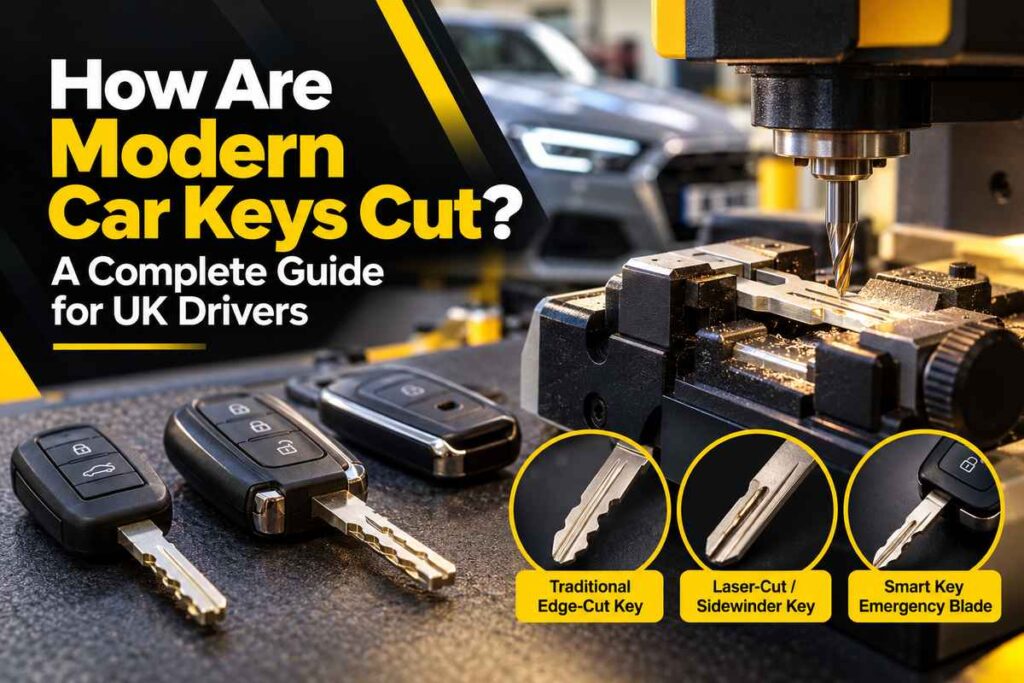
Modern car keys are cut using specialist machines that reproduce the exact shape, groove pattern or key code required by a vehicle’s lock. Depending on the car, the locksmith may copy an existing working key, cut a new blade from key data, or use a precision milling machine for more advanced sidewinder-style keys.
The important point is that car key cutting and car key programming are not the same thing. Cutting creates the physical blade. Programming deals with the electronic side of the key, such as the transponder chip or immobiliser.
For many modern vehicles, both stages are needed before a replacement key is fully usable.
What Does Car Key Cutting Actually Do?
Car key cutting creates the physical part of the key that fits into the vehicle’s mechanical lock.
On a traditional key, this means shaping the edges of a metal blank so they match the pattern used by the lock.
More modern blades can have channels, grooves or milled tracks through the centre of the key. These designs need more precise machinery than an ordinary household-key cutter.
The aim is the same in every case: the finished blade must match the vehicle’s lock closely enough to move the internal components smoothly and correctly.
Even a small cutting error can make a key difficult to insert, hard to turn or completely unusable.
Step 1: Identifying the Correct Key Blank
Before any cutting takes place, the correct key blank has to be selected.
A key blank is an uncut key blade designed for a particular range of locks or vehicles. It already has the correct general shape but does not yet have the unique pattern needed for a specific car.
The locksmith may consider the vehicle’s make, model, year and key design when choosing the blank.
The correct blank matters because differences in blade width, thickness, length and groove position can prevent an otherwise well-cut key from working.
Modern vehicles can use several different blade designs, so automotive key cutting is much more vehicle-specific than simply choosing a piece of metal that looks similar.
Step 2: Reading the Key Pattern
Once the correct blank has been identified, the locksmith needs the cutting information.
There are two common ways this can happen.
Copying an Existing Working Key
If you already have a working key, its blade can often be used as the pattern for another key.
A key-cutting machine reads or follows the shape of the original and reproduces that pattern on the new blank.
This is commonly used when making an additional key while the original is still available.
Having a working key can make the mechanical part of the job more straightforward. It is one reason arranging a backup before the only working key disappears can be useful. You can read more about the practical benefits in our guide on why you need a spare car key.
Cutting From Key Data
A replacement key does not always have to be copied directly from an existing blade.
In some situations, a locksmith can use the correct key data or code to cut the blank to the required dimensions.
This is usually known as code cutting.
Rather than tracing a worn key, the cutting machine follows the original specification for the lock.
This can be particularly useful when the original key is unavailable or badly worn, although the full process of replacing a completely lost key can involve additional identification and security steps.
If every working key has been lost, see our guide on what to do after losing your only car key.
Step 3: Cutting or Milling the Blade
The next stage is the physical cutting.
The blank is secured in a specialist machine so it cannot move while the blade is being shaped.
The machine then removes small amounts of metal according to the required pattern.
Older-style keys may use cuts along the outer edges of the blade. More advanced vehicle keys may require precision milling through the face or centre.
The type of machine depends on the key design.
Accuracy is important because automotive locks are designed to work with a very specific pattern. A key that is slightly too deep, too shallow or incorrectly aligned may not operate the lock properly.
This is why modern car key cutting relies heavily on calibrated equipment rather than rough manual copying.
Traditional Edge-Cut vs Laser-Cut Car Keys
Not all car key blades are made in the same way.
Traditional edge-cut keys and so-called laser-cut keys look quite different.
| Feature | Traditional Edge-Cut Key | Laser-Cut / Sidewinder Key |
|---|---|---|
| Cut location | Along the blade edges | Through the centre or face |
| Typical design | Teeth-like profile | Milled groove or track |
| Equipment | Standard automotive cutter | Precision milling machine |
| Common use | Many older vehicles | Many newer vehicles |
| Cutting complexity | Generally lower | Generally higher |
Traditional keys normally have visible cuts along one or both edges.
A sidewinder-style key often has a thicker blade with a groove running through the centre. It may be reversible, meaning it can be inserted into the lock either way up.
These designs require accurate milling rather than simple edge cutting.
Are Laser-Cut Car Keys Really Cut With a Laser?
Usually, no.
The term laser-cut key is widely used in the automotive industry, but it can be misleading.
In most cases, the blade is not being cut by a laser beam. Instead, a precision milling cutter removes metal from the key to form the groove.
“Laser-cut” generally refers to the style and accuracy of the blade rather than the literal cutting tool.
These keys are also commonly called sidewinder keys because of the distinctive winding groove through the blade.
This distinction is useful because it explains why a normal key-copying machine may not be suitable for every modern car key.
How Are Smart Car Keys Cut?
Smart and proximity keys may look completely electronic, but many still contain a physical emergency blade.
The blade is often hidden inside the key fob.
It can be used in situations where the remote system or vehicle battery is not operating normally, depending on the car.
The emergency blade still needs to be cut to match the mechanical door lock.
This means even a keyless vehicle can involve traditional mechanical key cutting as part of the replacement process.
The smart electronics and the blade perform different jobs.
Why Precision Matters
A badly cut key may appear close enough to the original but still cause problems.
It may not enter the lock smoothly. It may require excessive movement before turning. It might operate one lock but struggle with another.
Repeatedly forcing a poor-quality key can also increase wear on the lock or ignition.
Good automotive key cutting therefore depends on several things working together: the correct blank, accurate cutting data, a properly calibrated machine and final testing.
The finished key should operate smoothly rather than needing force.
Is Car Key Cutting the Same as Programming?
No.
This is one of the most important distinctions with modern car keys.
Cutting creates the physical blade.
Programming allows the electronic part of the key to communicate with the vehicle.
A transponder-equipped key may be cut perfectly and still fail to start the car if its chip has not been recognised by the immobiliser.
Similarly, a smart key may need electronic setup even though its hidden emergency blade has already been cut.
So when a modern replacement key is made, the job may involve both a mechanical and electronic stage.
If you need a replacement or additional key, a professional car key cutting service can identify the correct blade type and determine whether programming is also required.
Can Any Key-Cutting Machine Cut a Modern Car Key?
Not always.
Basic key machines are suitable for many traditional keys, but modern automotive blades can require more specialised equipment.
Sidewinder blades, unusual grooves and manufacturer-specific designs may need dedicated cutters and software capable of working to precise measurements.
Certain specialist blade types, including Tibbe-style keys, can also require different tooling.
The key profile must therefore be matched with the correct machine rather than treated like a standard household key.
What Happens After the Key Is Cut?
The blade should be checked to make sure it operates the relevant lock correctly.
Depending on the vehicle, that may include testing the door lock or ignition.
If the key contains a transponder, remote controls or smart-key functions, electronic setup may follow.
The final result should be a key that is mechanically accurate and, where required, electronically recognised by the vehicle.
That separation between the physical blade and electronic security system is the easiest way to understand how modern car keys are made.
Final Thoughts
Modern car keys are cut using precise automotive machinery rather than a one-size-fits-all copying process.
The locksmith first identifies the correct blank, then obtains the blade pattern from an existing key or suitable key data. The blank is then cut or milled to match the vehicle’s lock.
Traditional edge-cut keys are generally simpler, while sidewinder or “laser-cut” keys require more precise milling equipment. Smart keys can also contain hidden emergency blades that still need mechanical cutting.
For modern vehicles, cutting is often only one part of the job. The physical blade must fit the lock, while the electronic side of the key may also need to be recognised by the vehicle.
Understanding that difference explains why modern car key replacement involves considerably more precision than simply copying an old metal key.